YouTube is doubling the bar to join the Partner Program for ad revenue. From 1 February 2027, new applicants need 1,000 subscribers plus either 8,000 qualified watch hours in the last 365 days or 20 million qualified Shorts views in the last 90 days. Channels already in the program keep their place, but they need to accept updated terms in YouTube Studio by 31 January 2027, and Shorts revenue gets a new monthly threshold of its own.
YouTube describes these as "the first significant changes since 2018" (YouTube blog, 10 August 2026). This blog covers what's changing, who it affects, what to do before the deadline, and what the new numbers mean in views.
What's changing on 1 February 2027
There are five changes. Only the first affects channels that haven't joined yet; the rest apply to channels already in the program (YouTube Help):
The subscriber requirement stays at 1,000. So does everything outside the numbers: 2-Step Verification, advanced features, no active Community Guidelines strikes and a linked AdSense account. Our guide to YouTube monetization eligibility covers those in full.
The new entry thresholds, before and after
For a channel applying for ad and Premium revenue, the watch-hours and Shorts paths both double. YouTube's own wording: "New creators applying for YPP will need 8,000 qualified watch hours in the last 365 days" or 20 million qualified Shorts views in the last 90 days (YouTube blog).
As before, you need one path or the other. Watch time from the Shorts feed doesn't count toward watch hours, and the two don't combine.
Here's the ad revenue section of the Earn page in YouTube Studio, captured in October 2026. It's a small channel's real progress, and the targets on the right are the figures that double in February:
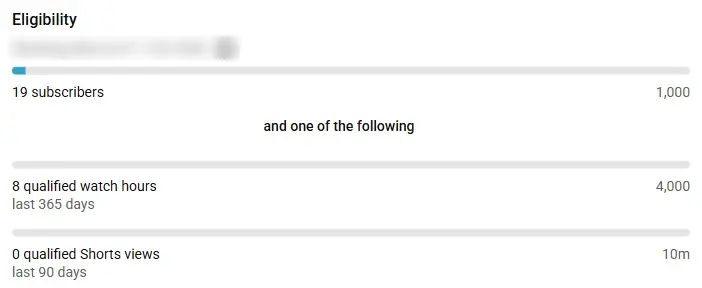
- 11,000 subscribers: unchanged
- 24,000 watch hours: becomes 8,000
- 310m Shorts views: becomes 20m
What 8,000 watch hours means in views
Watch hours are easier to picture as views. 8,000 hours is 480,000 minutes, so the views you need in a year depend on how long each viewer watches:
The table shows that view duration matters as much as views. A channel whose viewers watch 12 minutes needs fewer views to reach the new bar than a 3-minute channel needed for the old one. If you're working toward 8,000 hours, longer videos that hold attention move the number fastest. Your average view duration is in YouTube Studio under Analytics → Engagement.
The Shorts path scales the same way. 20 million views in 90 days is about 222,000 Shorts views a day, every day, for three months.
If you're already in the Partner Program
The higher entry bar doesn't apply to you. YouTube says plainly: "This update won't impact creators already in YPP" (YouTube blog). But there's one deadline you can't ignore.
Accept the updated modules by 31 January 2027
Your Partner Program agreement is made of modules, and three of them are being updated (YouTube Help):
- Watch Page Monetization Module: ads and Premium revenue on long-form videos.
- Shorts Monetization Module: revenue from the Shorts feed.
- Commerce Product Module, where it applies: memberships, Supers and other fan funding. Channels on the older Commerce Product Addendum are being moved to it, with the same revenue share.
YouTube's instruction is direct: "To continue fully monetizing your content, review and accept the updated terms in YouTube Studio by January 31, 2027." You'll find them on the Earn page.
You can accept some modules and not others, though YouTube recommends accepting all of them. Your decision doesn't affect your channel's status in the program.
The 2027 Partner Program timeline
- Step 110 August 2026YouTube announces the changes and opens the updated terms.
- Step 2NowExisting partners review and accept the updated modules on the Earn page.
- Step 331 January 2027Last day to accept without a gap in earnings.
- Step 41 February 2027New entry thresholds, the Shorts revenue threshold and activity rules take effect.
The Shorts revenue threshold
This change affects existing partners most. From 1 February 2027, a channel needs at least 10 million qualified Shorts views in the last 90 days to earn from the Shorts Creator Pool, the shared pool of Shorts ad revenue (YouTube Help).
It's checked every month. YouTube measures the 90 days ending on the 15th of the month before: earnings for March depend on views in the 90 days to 15 February. That means:
- Below 10 million that month: no Shorts Creator Pool revenue for that month. The channel stays in the Partner Program and keeps earning from long-form videos.
- Back above 10 million: Shorts revenue sharing restarts automatically, with nothing to reapply for.
- Above it: nothing changes. You keep 45% of your allocated revenue, as today.
YouTube says creators who already earn significant Shorts revenue are "unlikely to be impacted". The line works out at about 3.3 million qualified Shorts views a month, so channels whose Shorts average less than that will see Shorts revenue stop. For them, YouTube says it is planning milestone-based incentives instead, including bonuses for YouTube Shopping, brand deals and starting trends, with details still to come.
There's also a new upside. If an advertiser targets a Shorts ad at five or fewer channels, eligible creators will earn 45% of that ad's net revenue directly, on top of their Creator Pool earnings.
New rules for staying active
YouTube can already turn off monetization for channels that stop uploading. From 1 February 2027 the rule is clearer: a channel counts as active if it meets any one of these (YouTube Help):
- 1,000 qualified watch hours in the last 365 days
- 1 million qualified Shorts views in the last 90 days
- 2 long-form uploads or 5 Shorts uploads every 90 days
A channel that drops below gets an extended 90-day window to get back above the watch-hours or Shorts-views mark. Uploading regularly is the simplest way to stay safe.
Premium Lite revenue
Premium Lite, the cheaper YouTube Premium plan, is expanding to every country where Premium is offered. Each plan gets its own revenue pool: 30% of net subscription revenue for Premium and 60% for Premium Lite. The pool is paid out by member watch time and views, and creators keep the usual 55% on long-form and 45% on Shorts (YouTube blog).
If you're not in the program yet
You have two routes, and only one gets harder.
The fan-funding tier doesn't change. Memberships, Supers, Shopping and Creator Partnerships still unlock at 500 subscribers, 3 public uploads in the last 90 days, and either 3,000 watch hours in 12 months or 3 million Shorts views in 90 days. Here's that tier on the same channel's Earn page:
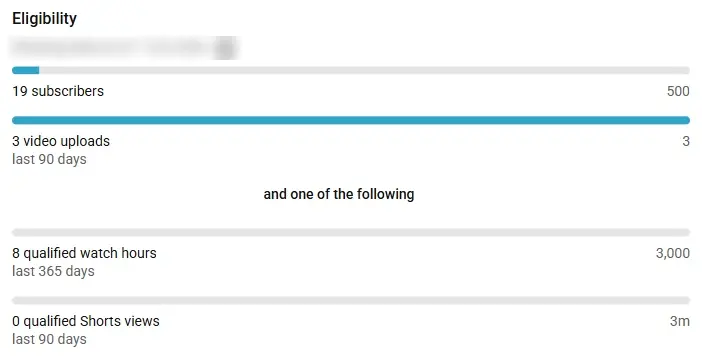
- 1500 subscribers
- 23 public uploads in 90 days
- 33,000 watch hours
- 4Or 3 million Shorts views
Ad revenue gets harder. If you won't reach 4,000 hours or 10 million Shorts views before February, plan for 8,000 or 20 million. If you're close, the timing matters:
- Check your Earn page now. It shows your exact qualified watch hours and Shorts views against today's thresholds.
- Apply as soon as Apply now appears. YouTube says reviews usually take about a month, and neither its announcement nor its Help pages say how applications still under review on 1 February will be judged. Applying in January leaves little margin.
- Get the rest ready early. Turn on 2-Step Verification and advanced features, and have an AdSense account ready, so nothing holds up your application once you're eligible.
How 2027 compares with 2018
The last big change came in January 2018, when YouTube replaced a 10,000-lifetime-views rule with today's 1,000 subscribers and 4,000 watch hours (YouTube blog, January 2018). The difference in how the two changes treat existing channels is the main thing to understand about 2027.
In 2018, channels under the new bar were removed from monetization after a 30-day grace period. This time, existing partners keep their place. The pressure on them comes from the monthly Shorts threshold and the activity rules instead. That makes 2027 harder to get into but less disruptive for channels already in, as long as they accept the new modules on time.
What to do now
The steps depend on where your channel is:
If you're assessing a channel that isn't yours, a sponsor or a competitor, the Monetization Checker compares its public figures with YouTube's thresholds. It can't see watch hours or Shorts views, which are private, so treat the result as a readiness signal rather than a verdict:
Once you're in, our guide to how much YouTube pays per 1,000 views explains RPM by niche and country, and the Earnings Calculator turns your views into a monthly estimate.
The core of the change: getting into the Partner Program for ad revenue takes twice the watch time from February 2027, but channels already in keep their place, as long as they accept the new terms by 31 January.